Breast density is an independent risk factor associated with the development of breast cancer.1, 2, 3, 4 Adding breast density to risk calculation has been shown to more accurately predict the risk for developing breast cancer. 5, 6 However, within a risk model, breast density risk calculation becomes one piece of the larger puzzle. Each risk model may calculate breast density risk differently. It’s important to understand how breast density risk is calculated and applied to the overall breast cancer risk calculation.
“If entering mammographic density, then it is also very important to enter height and weight to obtain the most accurate risk assessment for an individual woman.” 9 – Professor Jack Cuzick
Actual breast density – Predicted breast density = Residual breast density
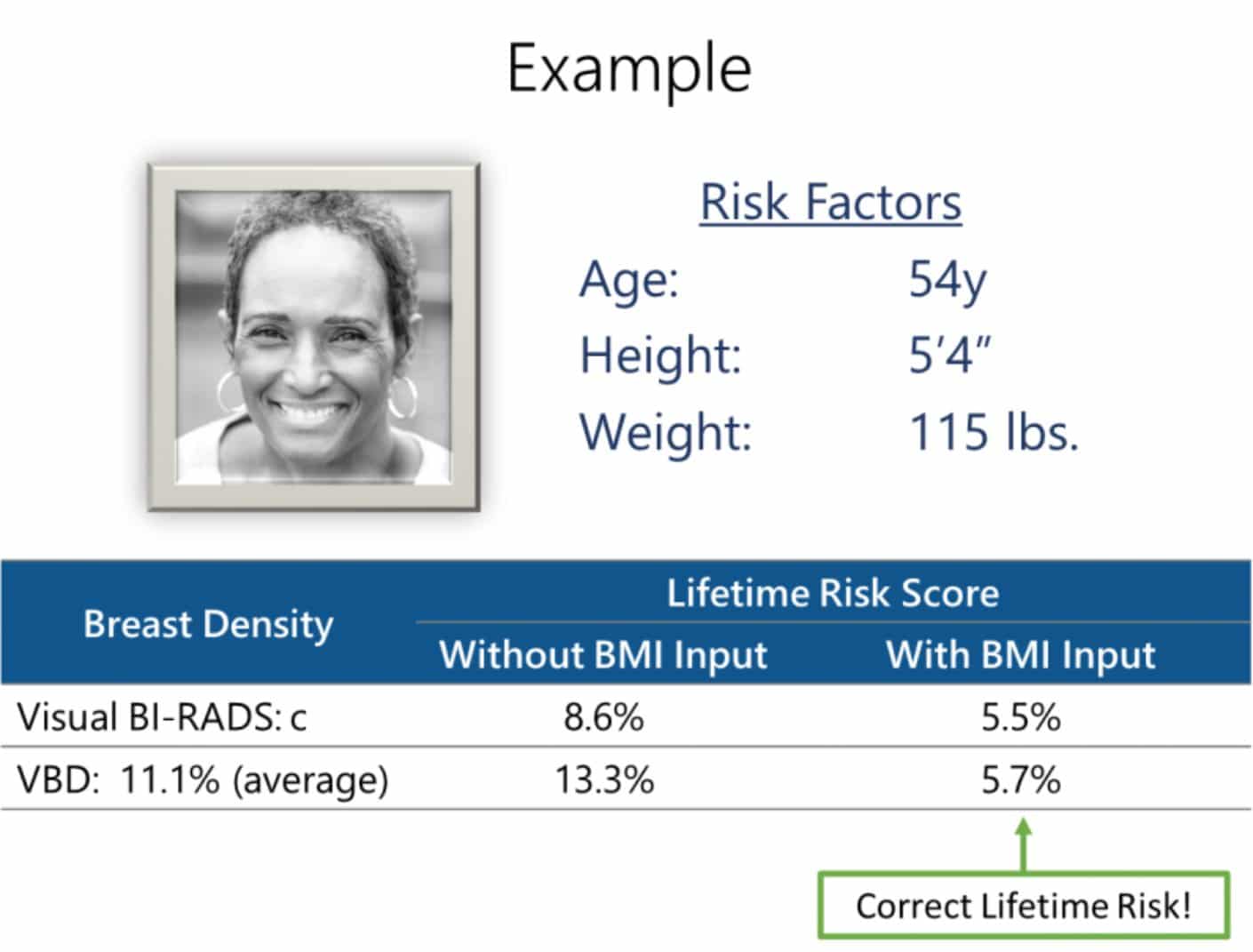
Let’s break that apart:In risk models like Tyrer-Cuzick where residual breast density is used in the calculation, additional factors like age, height and weight9, which were used to determine the predicted density value, must be included to ensure the accuracy of the model.
Omitting this information will result in a faulty or incorrect risk assessment.
In the example below, a woman’s lifetime risk score is calculated using the TC8 model with and without BMI information.